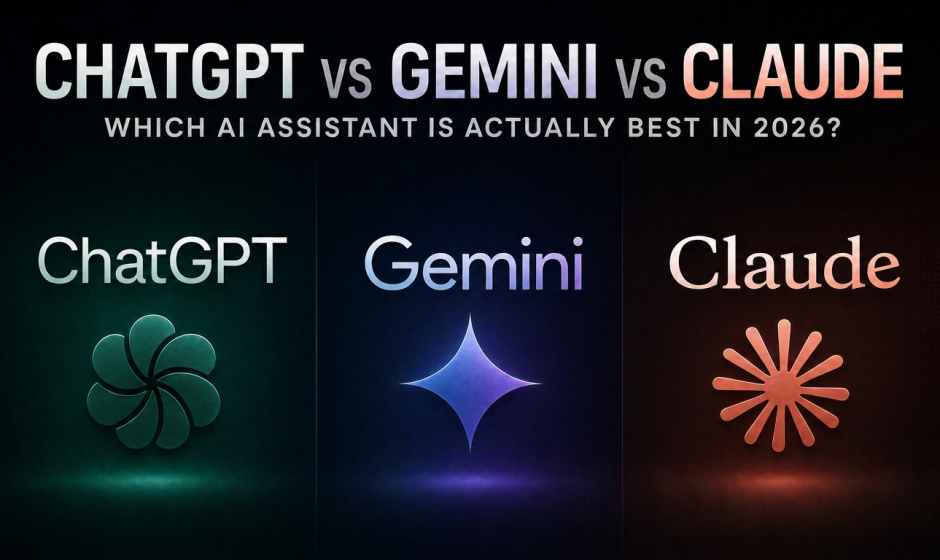

Artificial intelligence assistants have moved far beyond simple question-and-answer chat-bots.We will examine this topic here. Eventually we will decide which one is better to use? ChatGPT vs Gemini vs Claude comparison will be an ultimate advisor.
AI assistants can research complex subjects, analyze documents, write and debug code, interpret images, assist with everyday work, and increasingly perform multi-step tasks on a user’s behalf. But as their capabilities expand, choosing between the leading platforms has become more difficult.
Three names dominate much of the discussion: ChatGPT, Google Gemini, and Claude.
All three are highly capable. The more useful question in 2026 is no longer simply which AI is smartest? It is:
Which AI assistant is best for the work you actually want to do?
This comparison examines their strengths across research, writing, coding, reasoning, multi-modal work, productivity, ecosystem integration, and overall usability.
ChatGPT vs Gemini vs Claude: Quick Comparison
| Category | ChatGPT | Gemini | Claude |
|---|---|---|---|
| General-purpose use | Excellent | Excellent | Excellent |
| Writing | Excellent | Very good | Excellent |
| Coding | Excellent | Excellent | Excellent |
| Research | Excellent | Excellent | Excellent |
| Reasoning | Excellent | Excellent | Excellent |
| Multimodal work | Excellent | Excellent | Strong |
| Ecosystem integration | Strong | Excellent for Google users | Strong |
| Long-form knowledge work | Excellent | Excellent | Excellent |
| Everyday versatility | Excellent | Excellent | Very good |
There is no universal winner in every category. Each platform has developed characteristics that make it particularly attractive for certain users.
1. ChatGPT: The Versatile All-Rounder
ChatGPT remains one of the broadest general-purpose AI platforms available.
Its main advantage isn’t limited to one particular capability. Instead, ChatGPT combines writing, reasoning, research, coding, file analysis, image-related capabilities, voice interaction and other tools within one environment.
That makes it particularly useful for people whose requirements change throughout the day.
A user might begin by researching a subject, ask ChatGPT to organize the findings, analyze an uploaded document, work through a technical problem, and later turn the information into a presentation or other deliverable.
Where ChatGPT stands out
- Broad range of capabilities
- Strong reasoning and problem solving
- Coding and technical assistance
- Research-oriented workflows
- File and document analysis
- Multimodal interaction
- Flexible use across many different types of work
This breadth is important. A specialized AI can outperform a competitor for a particular task while still being less convenient as someone’s primary assistant.
Where ChatGPT may not be the obvious choice
People whose work takes place almost entirely inside Google’s ecosystem may find Gemini’s native integration more convenient.
Likewise, users focused overwhelmingly on particular forms of long-form writing or coding may prefer aspects of Claude’s workflow.
Best suited for: Users who want one AI environment capable of handling many different kinds of work. You may check the ChatGPT website for more.
2. Gemini: The Google Ecosystem Advantage
Gemini’s greatest strategic advantage is obvious: Google already owns many of the applications people use every day.
Search, Gmail, Drive, Docs, Android and other Google services provide an enormous ecosystem around Gemini.
That changes the nature of the competition.
Gemini does not need to function merely as a chatbot. It can become an AI layer across Google’s products.
Google’s current AI plans provide access to Gemini’s more capable models and features such as Deep Research, with higher tiers expanding access further.
Where Gemini stands out
- Deep integration with Google’s ecosystem
- Strong research capabilities
- Multi-modal AI
- Access across Google applications
- Strong productivity potential
- Useful for users already heavily invested in Google services
For someone who spends much of the working day using Gmail, Docs, Drive and other Google products, integration can matter just as much as differences in model performance.
Where Gemini may not be the obvious choice
Users who do not depend heavily on Google’s ecosystem may find some of that advantage less significant.
Gemini therefore becomes particularly compelling when its AI capabilities are combined with services a user already depends upon.
Best suited for: Google-centric users, researchers and people who value tight integration between AI and productivity applications. You may check the Gemini website for more.
3. Claude: A Serious Competitor for Knowledge Work and Coding
Claude has established itself as much more than an alternative chat-bot.
Anthropic has increasingly positioned Claude around demanding knowledge work, coding, tool use and agentic workflows. Claude Sonnet 5, released in June 2026, continued that direction with stronger agentic capabilities and the ability to work with tools such as browsers and terminals.
Claude’s interface and response style can also make it attractive for users working with substantial amounts of text.
Where Claude stands out
- Long-form writing and editing
- Coding
- Complex knowledge work
- Structured analysis
- Agentic workflows
- Working through detailed instructions and documents
Claude can be particularly attractive to programmers, researchers, writers and professionals who want to spend a long session developing one complex piece of work.
Where Claude may not be the obvious choice
ChatGPT and Gemini surround their core models with extremely broad consumer ecosystems.
For someone seeking an all-purpose personal assistant incorporating a wide variety of media, productivity and everyday features, those surrounding ecosystems can influence the decision.
Best suited for: Developers, writers and users doing intensive knowledge work. You may check the Claude website for more.
Research: Which Is Best?
Research is one of the most important areas of competition.
Modern AI research is no longer simply a matter of asking a model what it remembers. Good research workflows can involve searching current sources, examining multiple documents, synthesizing evidence and presenting conclusions.
ChatGPT, Gemini and Claude have all developed increasingly sophisticated research capabilities.
For most users, the more important question is therefore not whether an assistant can research. All three can.
Instead, evaluate:
- How well does it find relevant sources?
- Does it distinguish evidence from inference?
- Can you verify its claims?
- Does it synthesize information rather than merely summarize it?
- How well does it follow a complex research brief?
Verdict
There is no responsible universal winner without running the same research task under controlled conditions.
For serious work, users should test the assistants on the type of research they actually perform rather than relying solely on benchmark scores. You can also explore our guide to “Best Free AI Video Tools” for a closer look at how modern AI tools are changing everyday technology.
Writing: ChatGPT vs Gemini vs Claude
Writing is another area where simplistic rankings can be misleading.
The “best” writing assistant depends heavily on what is being written.
A marketing headline, technical article, business email, screenplay and academic explanation require different qualities.
ChatGPT
Strong at adapting to different formats and repeatedly revising content through conversation.
Gemini
Capable writing combined with the advantage of integration into Google’s productivity environment.
Claude
Particularly attractive for extended prose, editing, document-heavy tasks and sustained long-form work.
Verdict
Long-form writing: Claude deserves serious consideration.
Flexible everyday writing: ChatGPT is exceptionally versatile.
Writing inside a Google-centered workflow: Gemini has an obvious convenience advantage.
The important word is workflow. Quality differences between leading models can be smaller than the productivity difference created by using the right tool for your environment.
Coding: The Competition Is Much Closer Than It Used to Be
AI coding has evolved rapidly.
Today’s leading assistants can explain unfamiliar code, generate functions, locate bugs, suggest architecture, work with repositories and participate in increasingly autonomous development workflows.
ChatGPT has a strong coding ecosystem, including OpenAI’s Codex-related tools.
Claude has become particularly prominent in software-development workflows through Claude Code and Anthropic’s focus on agentic coding.
Google, meanwhile, combines Gemini models with its own developer ecosystem and coding products.
What developers should actually compare
Don’t select a coding assistant because it solved an isolated programming puzzle.
Test it against realistic work:
- Understanding an unfamiliar project
- Finding a subtle bug
- Refactoring existing code
- Writing tests
- Explaining its changes
- Following project-specific requirements
- Maintaining consistency across multiple files
For professional programming, reliability across an entire workflow matters more than producing one impressive snippet.
Reasoning and Problem Solving
Reasoning benchmarks generate headlines, but benchmark leadership does not automatically translate into the best everyday assistant.
Users rarely spend their entire day solving standardized tests.
Real tasks contain ambiguity, incomplete information and changing requirements.
A useful reasoning assistant should be able to:
- Break complicated problems into manageable parts
- Recognize uncertainty
- Ask for missing information when necessary
- Compare alternatives
- Correct itself when new evidence appears
- Explain conclusions clearly
All three platforms are now serious reasoning tools.
For ordinary users, differences in workflow and tools may therefore matter more than small differences on individual benchmarks.
Multi-modal AI: Text Is Only Part of the Story
The AI assistant is increasingly becoming a multi-modal interface.
Users now expect AI to understand combinations of text, images, documents, audio and other media.
ChatGPT and Gemini have invested heavily in multi-modal interaction, while Claude also supports visual and document-oriented workflows.
This matters because many real problems aren’t purely textual.
A user might want an AI assistant to examine:
- A screenshot containing an error
- A chart
- A PDF
- A photograph
- A spreadsheet
- A user-interface problem
- A diagram
For many consumers, the best AI will eventually be the one that handles these different information formats most naturally.
Free vs Paid: Do You Actually Need a Subscription?
Before paying for any AI service, use its free version.
The free tiers of major AI platforms are increasingly capable, although usage limits and access to advanced models or features vary.
Paid subscriptions generally become worthwhile when AI has become part of your daily workflow.
Consider paying if you regularly need:
- Higher usage limits
- More capable models
- Advanced research
- Intensive coding assistance
- Larger or more frequent file analysis
- Premium productivity features
- Advanced multi-modal tools
Casual users may discover that they don’t need a paid subscription at all.
And because AI plans change frequently, always check each provider’s current pricing page before purchasing.
Which AI Should You Choose?
The answer becomes easier when we stop trying to crown one universal winner.
Choose ChatGPT if…
You want a highly versatile general-purpose assistant that can move between research, reasoning, writing, coding, files and multi-modal tasks.
Choose Gemini if…
You rely heavily on Google’s ecosystem and want AI closely integrated with the applications and services you already use.
Choose Claude if…
Your priorities include coding, long-form writing, document-heavy work and demanding knowledge tasks.
Use more than one if…
AI is important to your professional workflow.
There is no rule requiring users to remain loyal to one AI platform.
A writer could prefer Claude for developing a long document, use Gemini for a Google-centered workflow and use ChatGPT for research, analysis or another multi-modal task.
The tools can complement rather than simply replace one another.
Final Verdict: ChatGPT vs Gemini vs Claude
So, which is the best AI assistant in 2026?
There isn’t one defensible answer for every user.
ChatGPT is arguably the strongest choice for users prioritizing overall versatility.
Gemini becomes especially compelling for people deeply embedded in Google’s ecosystem.
Claude deserves particular attention from developers, writers and professionals doing intensive knowledge work.
More importantly, the competition changes quickly.
A model that leads one category today can be overtaken after another company’s next release. Features that once required expensive subscriptions can migrate into cheaper plans or free tiers.
For that reason, don’t choose an AI assistant based solely on brand loyalty or benchmark headlines.
Choose according to your workflow.
The best AI assistant is ultimately the one that helps you complete your actual work more accurately, efficiently and consistently.
Frequently Asked Questions
Is ChatGPT better than Gemini?
Neither is universally better. ChatGPT is particularly strong as a versatile general-purpose environment, while Gemini’s integration with Google’s ecosystem can make it more convenient for users heavily dependent on Google products.
Is Claude better than ChatGPT for writing?
Claude is particularly strong for long-form and document-oriented work, while ChatGPT provides substantial flexibility across many writing styles and workflows. The better choice depends on the type of writing.
Which AI is best for coding?
ChatGPT, Claude and Gemini all provide serious coding capabilities. Developers should test them against realistic projects rather than judging them from a single generated code sample.
Can I use ChatGPT, Gemini and Claude for free?
All three platforms offer ways to use their services without subscribing, although model availability, features and usage limits can differ and change over time.
Should I pay for more than one AI assistant?
Most casual users don’t need to. Professionals whose work depends heavily on AI may benefit from multiple services because each platform has different strengths.
Which AI is best overall in 2026?
For general versatility, ChatGPT is a particularly strong choice. Gemini has a major ecosystem advantage for Google users, while Claude is highly competitive for coding, writing and intensive knowledge work.